


Cubicle Door
Craving cubicle privacy? Simple - get a cubicle door!
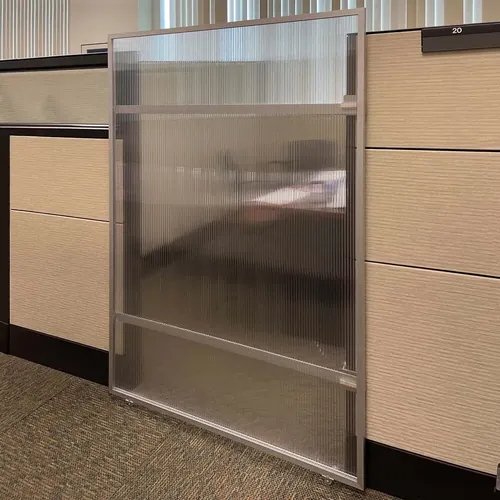
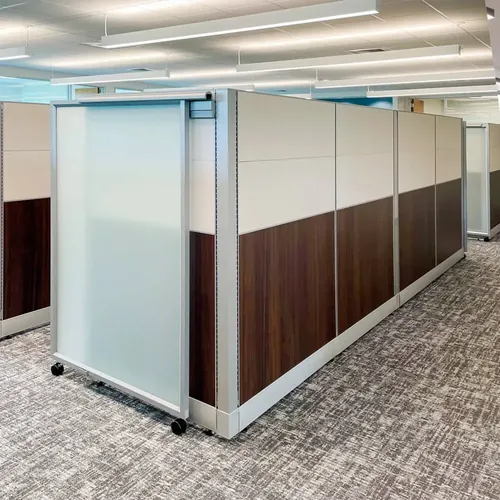
The office workstations for sale on this page come with built in frosted sliding doors on wheels that can help lessen unnecessary office distractions and provide workers with a valuable tool to help them say “not now, please” so they can concentrate on their tasks.
We offer the most common office cubicle layouts as singles, 2-packs, 3-packs, 4, and 6-packs, available in panel partition wall heights of either 53” or 67”. Each configuration comes standard with integrated electrical power and is available in all the popular standard cubicle sizes: 5x6, 6x6, 6x8, 8x8, and 8x12.
All cubicle doors offered on this page are part of, and integrated with our O2 cubicle system. These doors are only compatible with this system.
If you have A02 Herman Miller cubicles or their cloned cousins and want to order these doors without the cubicle to which they're attached too, just ask!
If you have a cubicle system furniture that is not AO2, check out our Universal Sliding Cubicle Door.
Not sure what door will work for your system? Just Ask!
Sliding Cubicle Door
Office Cubicle with Door 53H
-
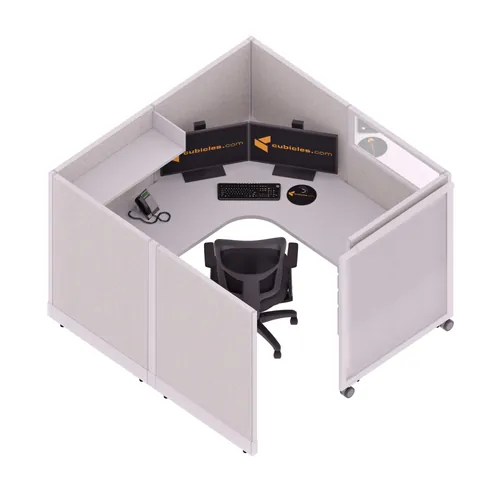
Cubicles with Sliding Doors 53H Single
-
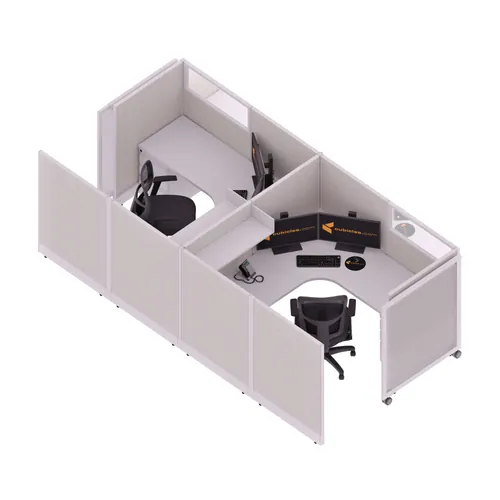
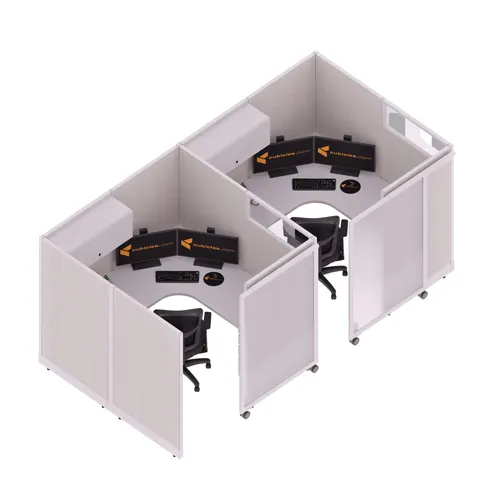
Cubicles with Sliding Doors 53H 2pack Cluster
-
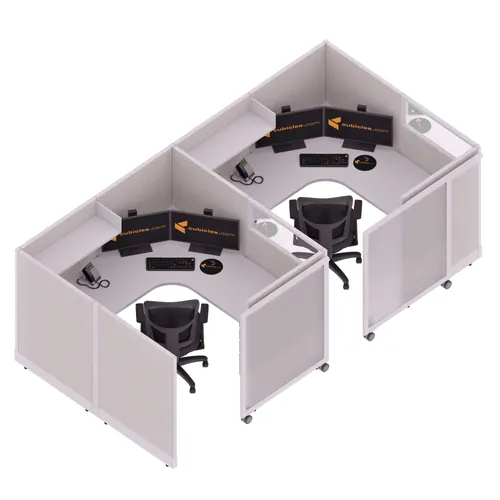
Cubicles with Sliding Doors 53H 2pack Inline
-
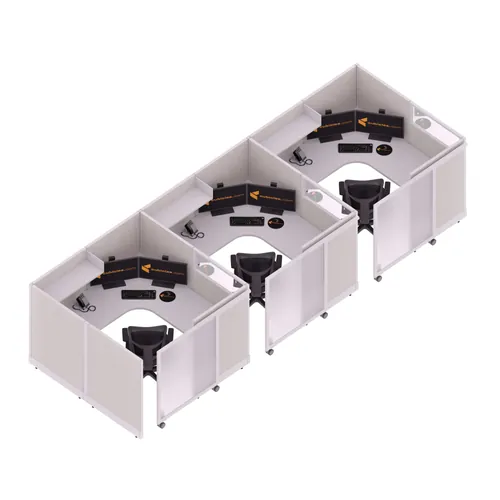
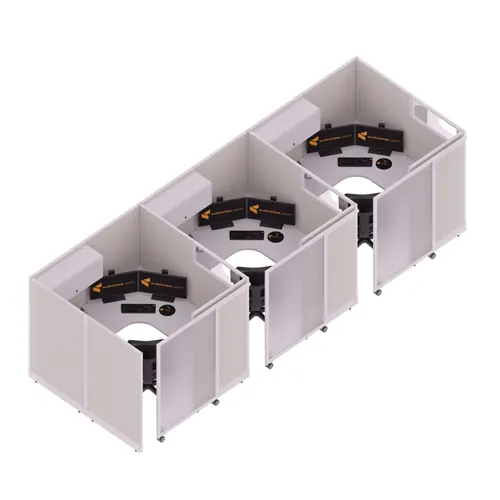
Cubicles with Sliding Doors 53H 3pack Inline
-
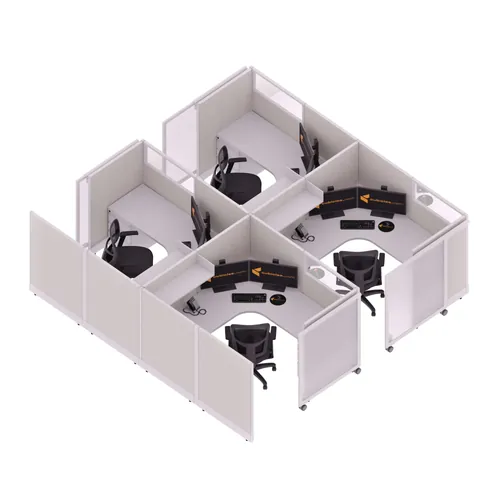
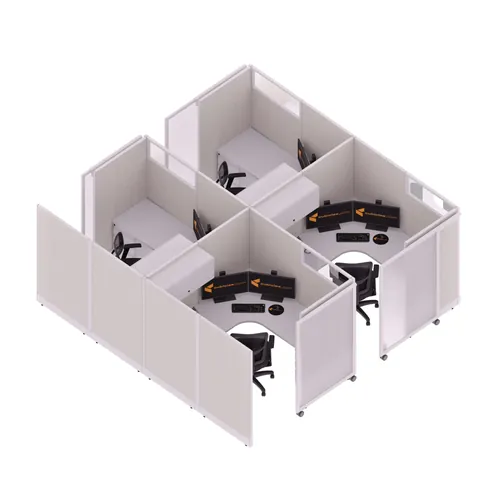
Cubicles with Sliding Doors 53H 4pack Cluster
-
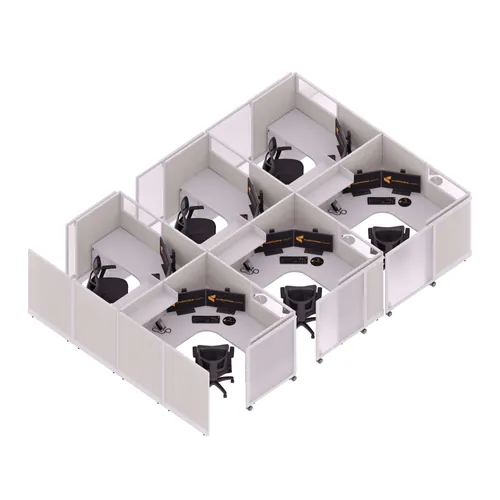
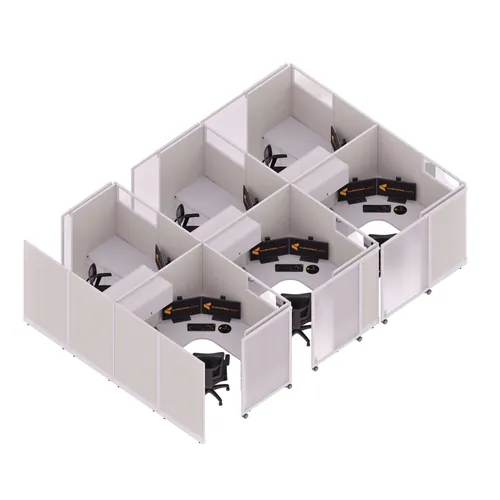
Cubicles with Sliding Doors 53H 6pack Cluster
-
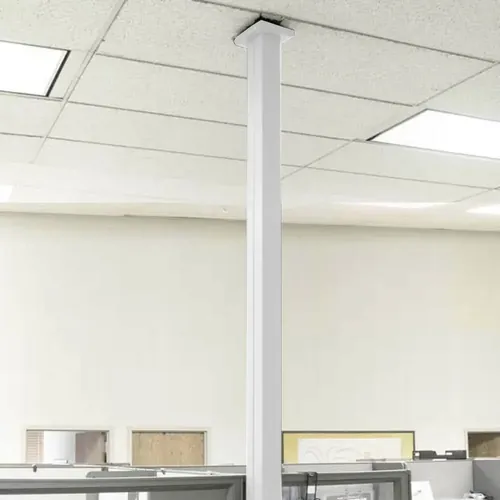
Commercial System Furniture Power Infeed
Office Cubicles with Doors 67H
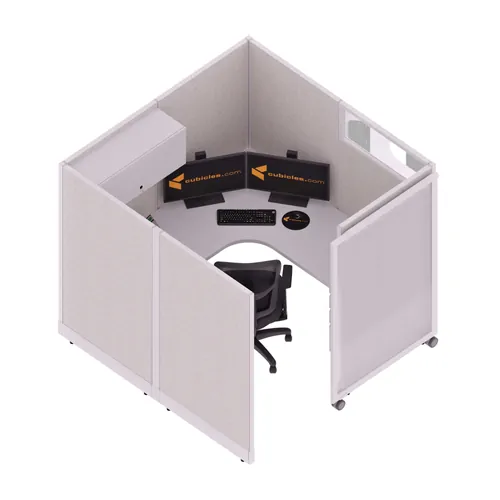
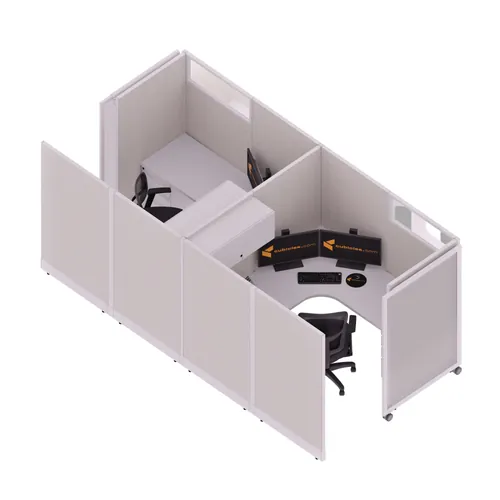

The pursuit of happiness nearly always includes a room with a view… and a cubicle with a door.
The O2™ Modular Office System is brilliantly simple: one product line with prolific possibilities.
It can provide traditional modular office furniture configurations, modular office walls, open plan office benching, hot desking, sit stand workstations, call center furniture… it can even adapt to the post-COVID social distancing office layout with desk screens & cubicle doors.
 Download the O2™ Brochure
Speaking of doors for cubicles…
CUBICLE DOOR PRIVACY = THE ULTIMATE DO NOT DISTURB SIGN
Alexander Graham Bell is credited with having said “When one door closes, another door opens.” He also invented the first practical telephone, a brilliant technological communication device best used with a degree of privacy. Doors… telephones… what was he thinking?
We’ve all been there. In ear shot of a co-worker on a sales call whose decibel level causes people to stop what they’re doing and listen. And surely, we’ve all overheard that personal call, when all ears in the room are leaning in and thinking: Hey, you, you with that phone – get a room! Ideally, one with a door!
Weapons of Mass Distraction
A nearby human on their phone is not the only culprit. Multitudes of audible and visual rings, pings and dingbats regularly conspire to steal your focus throughout the day. Don’t take our word for it, the world is awash with research on workplace distractions, the most common of which can potentially be reduced with the help of a dynamic duo: cubicle walls with doors.
#1: SPEECH PRIVACY
The University of Sydney, Australia, in conjunction with the Center for the Built Environment at UC Berkeley, surveyed more than 40,000 workers in more than 300 office buildings. In 2013 they published their findings in the Journal of Environmental Psychology - Workplace Satisfaction: The Privacy-Communication Trade-Off in Open Plan Offices. Unsurprisingly the abstract presenting their work is very telling:
“Occupants assessed Indoor Environmental Quality (IEQ) issues in different ways depending on the spatial configuration (classified by the degree of enclosure) of their workspace. Enclosed private offices clearly outperformed open-plan layouts in most aspects of IEQ, particularly in acoustics, privacy, and in (non-verbal) proxemics communications issues. Benefits of enhanced ‘ease of interaction’ were smaller than the penalties of increased noise level and decreased privacy resulting from open-plan office configuration.”
Say what now? Let’s simplify that:
The #1 complaint from people in cubicles, regardless of high or low office panels, is the lack of sound privacy. Poor speech privacy means you’re often distracted (and annoyed) by nearby conversations that are not intended for you. A’s conversation with B that you cannot C your way out of, no matter how hard you try! Furthermore, one of the most common grievances about office colleagues is a loud telephone voice.

#2: OFFICE CLUTTER
It’s true that many famous, creative minds have preferred a cluttered desk, but moderation is key. An overly messy office, especially in a shared area where you have limited control, can lead to confusion, anxiety, wasted time searching for items, and an inevitable decline in productivity.
MRI studies from the Princeton University Neuroscience Institute have shown that human brains like order, and disorganized visual stimulation can drain cognitive resources, reduce focus, and result in procrastination. The studies also showed that when you remove or reduce the distracting visuals, brain functions return to a higher level of focused, productive processing.

#3: BACKGROUND OFFICE NOISE
People chatting, coughing, and loudly snacking, keyboards clicking, machines running, phones ringing, doors opening & closing.
Office ambient noise is inevitable, and if not overdone can promote abstract processing and higher creativity for creative task workers and extroverts. If on the other hand you’re a routine task worker or introvert, or if your desk location is too close to the sound sources, chances are good that those sounds are not doing your brain any favors, according to Takeshi Akita of Tokyo Denki University.
The right balance is key and starting from the quietest place is decidedly advantageous. For those who think their office environment is too quiet, here’s an office-specific background noise generator that will fill your ears with all the ambient office noise your brain can manage.

#4: PEOPLE INTERRUPTIONS AT WORK
Co-workers, bosses, customers, vendors, and other people wandering by your office workspace all represent potential distractions.
Have you seen my report? Do you have any feedback? What do you think of the new proposal? What is that status of this or that? I don’t understand my order, can you help? Can you give me a revised bill? How are the new products doing in the market? When can we meet? Did you get the memo? What are you working on? What did you do this weekend? Are you working hard or hardly working?
Nothing quite proves “out of sight out of mind” as well as a closed office cubicle door. Unfortunately, they do nothing to eliminate ever-present cell phone distractions in the workplace.

More Office Distraction Stats & Studies
As reported by Gloria Mark, Professor in the Department of Informatics at the University of California, Irvine:
People switch work activities on average every 3 minutes 5 seconds, and from one work project or related “sphere” of activities to another every 10 minutes 30 seconds.
82% of interrupted work is resumed on the same day. However, after a significant unrelated intrusion, it can take up to 23 minutes 15 seconds to get back into the task.
These distractions at work can add up to over 2 hours a day.
Tasks requiring complex verbal processes are more vulnerable to broken focus and reduced productivity than relatively simple or routine tasks.
In a study of interrupted vs uninterrupted workers, the number of errors & amount of work output was about the same – people with steady interruptions just work faster to compensate. But their stress levels are much higher, which can lead to office burnout, workplace health issues, and decreased cognitive functions in the long run.

The Bottom Line
Workplace distraction like the ones listed above can lead to stress. Stress can lead to increased Cortisol. Cortisol affects areas of the brain where our executive functions reside. Stress can cost American businesses up to $190 billion every year in healthcare and related costs.
There are plenty of other sources of stress and interruption at work not mentioned above: Smartphones, emails, social and chat platforms, personal life, micromanagement, too many scheduled meetings, hunger, and more. A door for a cubicle is a not shield against ALL office environmental disturbances, but it can minimize manageable intrusions and controllable offenses that sap productivity.
BENEFITS OF A CUBICLE OFFICE DOOR
Doors – they’re great. What’s not to love about having your own private workspace with a sliding cubicle door that can slide open when you’re open to interactions, and slide closed when you’re closed to interruptions?
If you’re feeling somewhere in between, just stop halfway! Is your cubicle office privacy screen half-open or half-closed? Only you will know.
If your cubicle workstation has partition dividers that are 53” in height or higher, ask your doctor (office manager) if cubicle privacy doors are right for you. Side effects may include reduced awareness of office noise, a decrease in time-wasting office small talk, improved concentration at work, lower stress levels, faded frown lines, and occasional feelings of joy.
Reclaim your time by working in an office cubicle with a door.
THE O2™ DOOR FOR CUBICLE LAYOUTS: FEATURES & SPECIFICATIONS

Features of the O2™ Sliding Door on Wheels
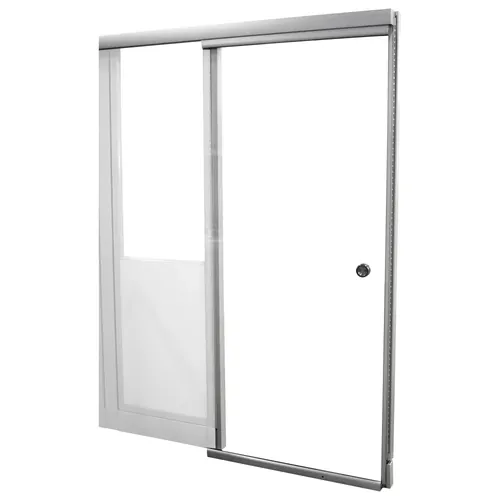
O2™ retractable cubicle doors are smartly designed and simple to use. The sliding door track kit will attach to a cubicle wall on either the left or right of the opening where you want to enclose the workstation. Our office partition door is equipped with sturdy, commercial grade door casters that roll smoothly across hard or carpeted office floors.
The construction of these doors on wheels is solid but lightweight. A brushed anodized aluminum frame offers strength & durability, painted to match your selected finish. The cubicle door screen itself is made from 5mm tempered frosted glass, providing an ideal level of translucence.
Frosted privacy glass does not block the flow of diffused light but obscures the view, helping people remain focused on what’s on their side of the cubicle privacy door.

As for how much this kind of sliding door on wheels can help with noisy office distractions, 5mm of glass will absorb and deflect a portion of the soundwaves crashing against your cubicle shores, especially background office noise.
Realistically you shouldn’t expect these doors to create anything close to a soundproof office. Nor can you expect to achieve ambient office noise reduction comparable to a fully enclosed private office surrounded by 4” thick floor to ceiling sheetrock walls and a solid core office door… or even to office walls with glass.
If office noise levels are sapping office productivity, mitigation is the key. One easy and effective answer to the proverbial question of how to soundproof an office is to add acoustic tiles to your existing office floor plan.

Schematics for O2™ Sliding Cubicle Doors
Our standard doors for office cubicles attach to 36” wide panels and cover a 36” opening. Optional sliding door track hardware can also accommodate cubicle partitions widths of 42, 48, or 60 inches.
The door kits fit on panel heights of 53” or 67” only. Other panel heights are not supported. These doors are engineered exclusively for our O2™ partition panels system, which is designed and built to match Herman Miller Action Office specifications. Aside from selling them here as part of a complete cubicle system, we also sell the doors separately to add to your existing compatible system. Just ask us!
If you’re looking to retrofit your existing office cubicle system and it’s not compatible with O2™, we can likely find a cubicle door that works with your model. Not shown here but also available are office cubicle doors for Haworth cubes, Knoll Cubicles or Teknion Cubicles systems. If you have another office furniture system, contact us to discuss alternative cubicle door ideas.
53”H CUBICLE WITH SLIDING DOOR

67”H CUBICLES WITH SLIDING DOORS

Office Furniture Assembly Tutorial: Sliding Doors for Cubicles
We offer a selection of office furniture installation videos on our cubicles.com YouTube channel, including this one on our O2™ retractable cubicle door. We also offer office furniture with assembly and delivery services included, if drill bits and mounting clips aren’t your thing!
A good rule of thumb when assembling office furniture: always confirm you have all the parts and hardware before you begin, and don’t throw away any packaging until you’ve completed the assembly. Now, watch the video. This doesn’t look too tricky, does it?
CASE STUDIES ON CUBICLE OFFICES WITH DOORS
Case Study #1
|
|
|
|


We provided this client with office space planning, interior design tips, and office furniture installation in the past. This office furniture layout consisted of seven large 8’x8’ O2™ Corporate Office Furniture Workstations with cubicle panels at 53”H.
As part of their business continuity plan for pandemic protocol they sought to modify the existing cubicle office furniture to create a safer, healthy work environment for their COVID weary team. To help mitigate pandemic spread we made the following modifications to the existing office layout:
Step 1 - We added 14”H plexiglass dividers to the 53”H desk divider panels between workstations, bringing the finished panel height to a COVID optimized 67”.
Step 2 - We added 14”H glass cubicle window “stackers” to the 24”W x 53”H aisleway panels, bringing them to 67”.
Step 3 - We removed and replaced the 36”W x 53”H aisleway panels with taller 36”W x 67”H panels.
Step 4 - We added a 36”W wheeled partition that slides open and shut to create an enclosed cubicle with door.
Step 5 - We added social distancing floor graphics at each entry point for enhanced coronavirus precautions.
In the final analysis, the conversion to taller privacy cubicles with door partitions was the ideal solution to add safety and privacy to the existing office furniture plan. This project is a case study in the potential end of the open-floor office as contemplated by the coronavirus office makeover report published in the NY Times in May 2020.
Case Study #2
|
|
|
|


Clearly an idea whose time has finally come: cubicles with doors!
The COVID-19 global pandemic sparked the concept of social distancing office design. It challenged the traditional approach to office interiors, particularly when considering the health and safety of workers in the shared office environment.
The same client from case study #1 came back to us for office furnishings for additional office facilities. This was a built-from-scratch small office design project and involved four enclosed workstations with office storage. With pandemic protocols in mind, we created high wall office cubicles with doors similar to the workplace design for their original location.
The successful use of cubicle sliding doors from the first office reconfiguration steered the design approach at this location and will become their new standard cubicle configuration moving forward.
THE OPEN & SHUT CASE ON OFFICE CUBICLES WITH DOORS
The cost differential of private office cubicles with doors vs. a private glass wall office vs. a traditional office surrounded by single-use sheetrock walls is a comparison worth making when planning an office buildout.
To emphatically reiterate the point: the construction of private offices with permanent office walls vs. private cubicle offices with modular walls is an option worthy of consideration in any office design plan.
Think about permanence vs flexibility, the available square footage per employee, the degree of privacy required, how office construction will align with building elements (beams, windows, stairwells, etc.), coworking dynamics, and more.
Creating office workstations by using office dividers with doors is a compelling value proposition and possibly the most cost-efficient way to provide employees with functional workspaces that bring people together, offer a modicum of privacy, and help limit unnecessary distractions.
One thing is clear: office partitions with doors are hard to beat in terms of ROI, lifespan, and reusability.
Now all you need is a cubicle doorbell, and you’re good to go!

Cubicles.com is not affiliated, associated, endorsed by, or in any way connected with Herman Miller, Inc. and is not an authorized dealer or representative of Herman Miller, Inc. Herman Miller, Inc. has not evaluated and does not confirm the compatibility of any cubicles.com product with any product of Herman Miller, Inc.