


O2™ Modular Office Walls
The top 3 reasons why O2™ modular office walls are the right solution:
- Assembly Line Built = AFFORDABLE
- Component Based = EASY TO SHIP & ASSEMBLE
- Demountable = REUSABLE
We can create a wide array of custom solutions for any order over 20 linear feet. But for this page, we offer our most popular sellers with no minimums.
The two most common applications
At the two most popular heights:
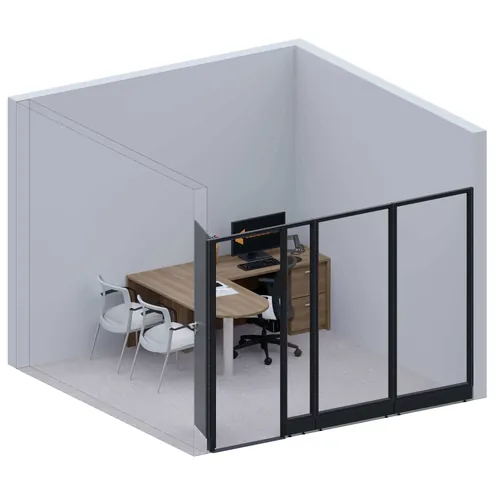
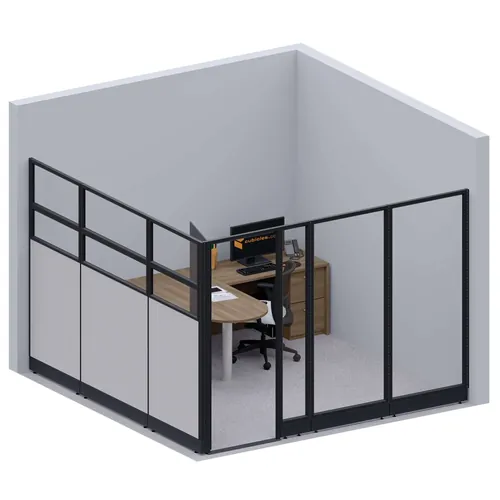
- Series 7 = 7 feet (85”H)
- Series 9 = 9 feet (107”H)
In the five most popular configurations (noted by alphabetical shape):
- I = 1 wall, straight line
- L = 2 walls, 90-degree angle
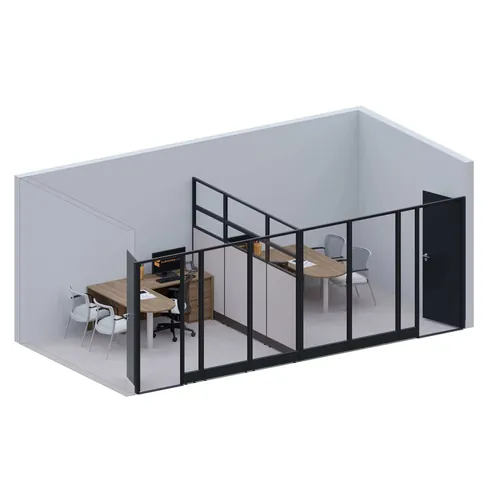
- T = 3 walls, creating two separate rooms
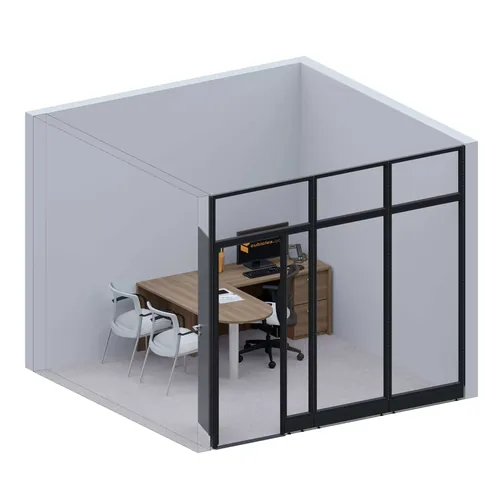
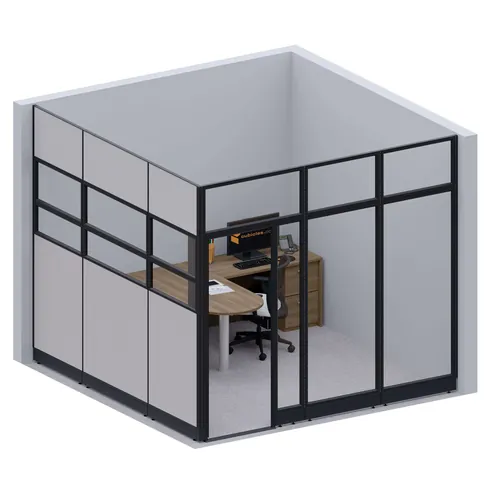
- U = 3 walls, surrounding one room on 3 sides
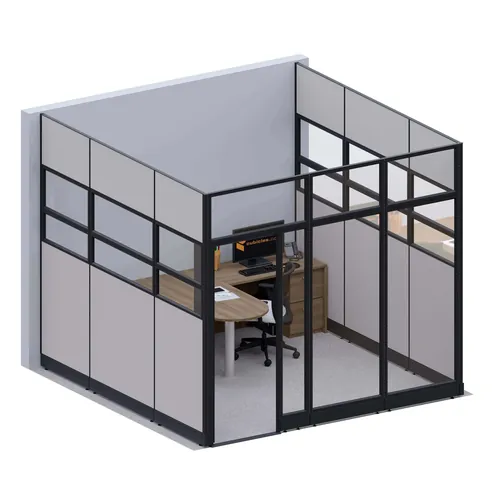
- O = 4 walls, fully surrounding one room
*Starting prices below are for the smallest footprint of each movable partition walls configuration. Final pricing depends on project details like size, customization, upgrades & downgrades, adding office furniture sets, and site location and conditions.
Office Walls System Series 7
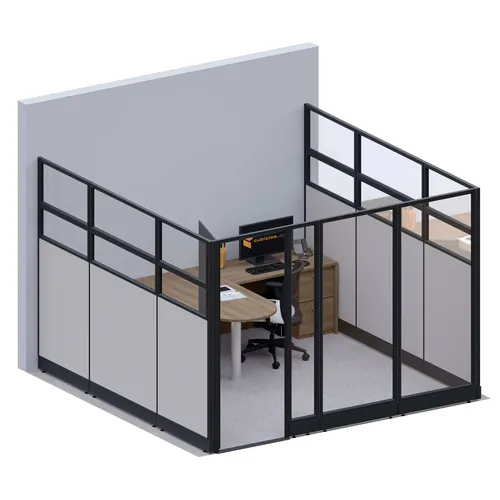
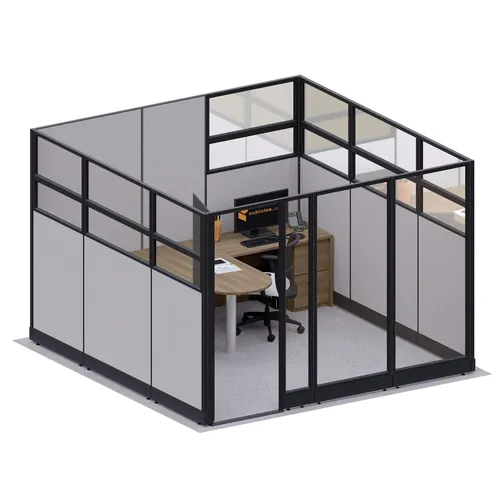
Office Walls Systems Series 9
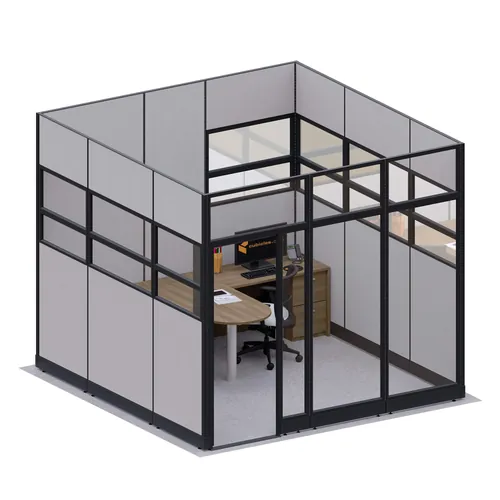
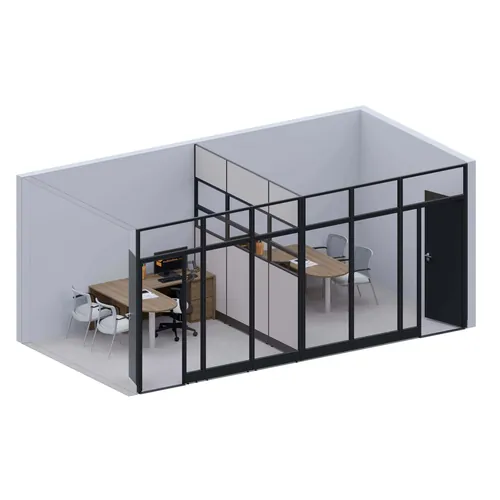
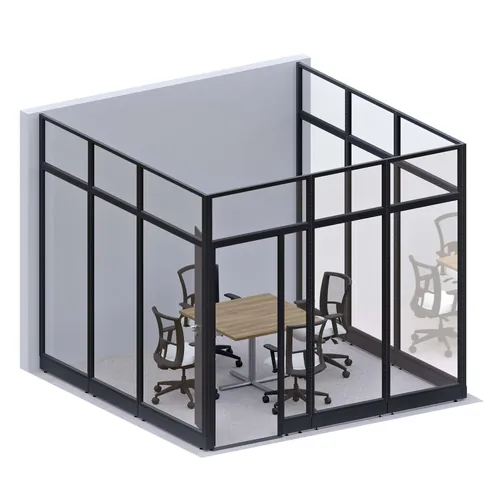
Modular Conference Room Series 7
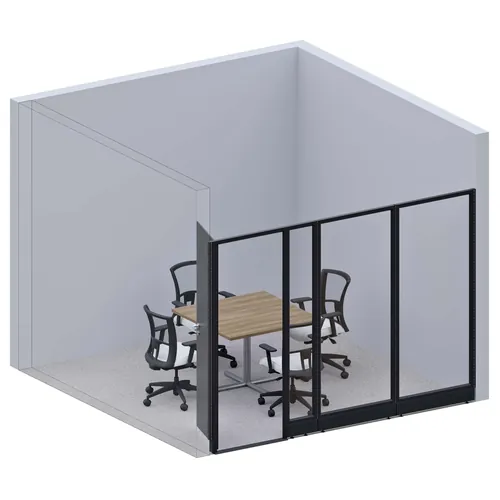
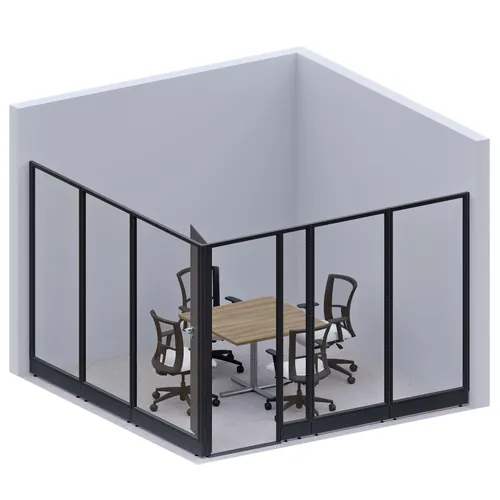
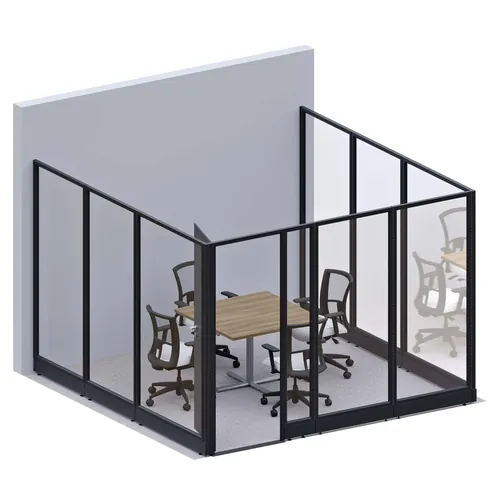
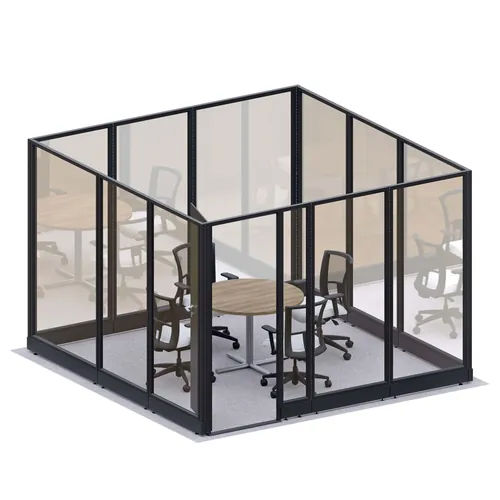
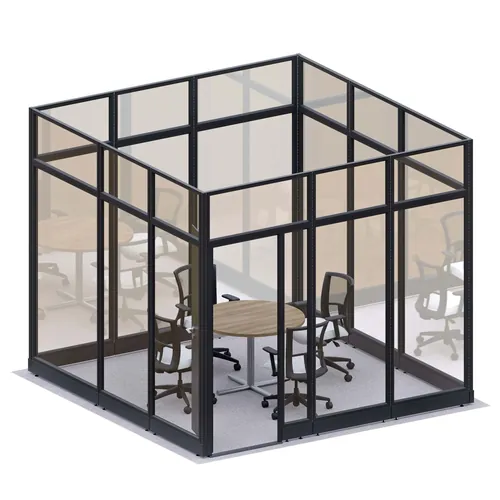
Modular Conference Rooms Series 9
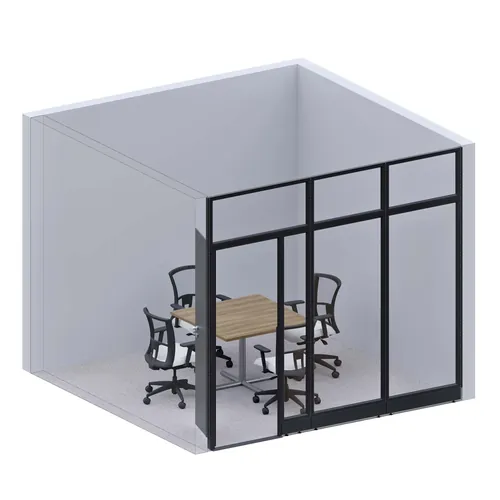
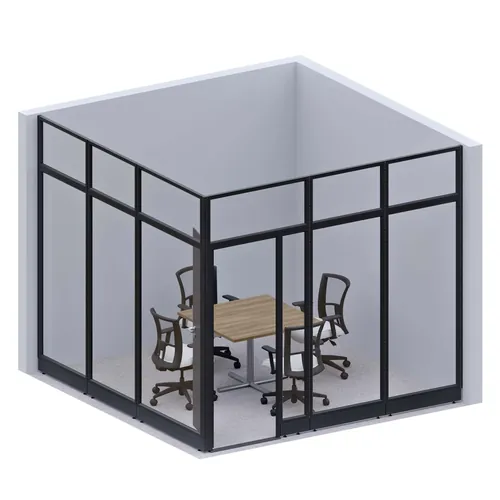
DEBUNKING THE OPEN CONCEPT OFFICE
The Ever-Swinging Pendulum of the Open Office Concept Through the Years
This century’s open office floor plan rose from the ashes of the dot com bust and the financial crisis that that followed. The Greenspan years-long zero interest rate solution sparked asset inflation, higher real estate values, and escalated commercial office rents. This created a refreshed interest in the open office layout and the reduced net square footage per office worker it offered.
To rationalize the open office concept, “workplace collaboration” became the buzzword to sell business managers on the idea that removing office walls, individual work spaces and private cubicle offices would lead to better productivity through collaboration in the workplace. But it wasn’t always workable in the real world.
This wasn’t the first rise of open collaborative office space plans. In fact, the pendulum of design for office interiors has been swinging back and forth for ages.
Here’s a quick recap on office design trends of the last 100 years:
 |
1920’s The Taylor Office Frederick Taylor, an American engineer, is one of the first to be recognized for a “modern” office space design. He greatly values efficiency and oversight. Employees crowd together in a single open room in a grid pattern of rows of desks, all facing the same direction so they can be visible by the supervisor (much like a traditional classroom). |
 |
1930’s The Bullpen Office The Wall Street Crash of 1929 results in a need to get work done quickly and cheaply. Frank Lloyd Wright works to humanize the Taylorist open office floorplan with aesthetically pleasing elements. As companies grow larger, they fit more employees into larger rooms in what becomes known as office bullpen layouts. |
 |
1940’s The Corporate Office We add fluorescent lighting and air conditioning, which leads to more flexibility in office space plans, since workers no longer need to be near windows for light or air. Which is unfortunate, considering how many people smoke at their desk! Globalized trade begins to rise again after World War II ends in 1945, increasing the size of the corporate population and commercial office spac square footage. |
 |
1950’s The Office Landscape In Europe, socialist values depart from Taylor’s “systems over people” priorities, recognizing that happy workers might be more productive. The German team Quickborner (brothers Wolfgang and Eberhard Schnelle) develops the “office landscape” (Bürolandschaft) which seeks to define interactive work group communities with curved office screens, elements of nature, pinwheel layouts, and organic geometry. |
 |
1960’s The Action Office Plan 1 The US embraces this reimagined open plan office. Office furniture companies expand on the concepts, most notably with the launch of Action Office of Herman Miller (by Propst) – the first modular business furniture system – with an interesting story. Version 1 (AO1), 1964: Propst envisions fluid and active offices. Panels are light and portable, and desks have sit-stand conversions and wheels. Workers have freedom & flexibility to stand or sit, stay, or move, be open or private. |
 |
1960’s The Action Office Plan 2 Unfortunately, the “active” part of Propst’s vision is never fully embraced because it’s too costly. Version 2 (AO2), 1968: A simpler, cheaper, and less “active” office panel system sells like hotcakes over the next several decades as an economical way to divide up an open office space… and then leave it that way. |
 |
1970’s The Regulated Office In Europe, an economic crisis leads many companies to abandon their large, air conditioned, artificially lit, open concept offices because they’re expensive… and most employees dislike the environment anyway. The US takes a different approach, keeping the open office affordable by overpopulating it. Work councils and labor unions begin to regulate standards for things like access to daylight and minimum space per employee. With white collar jobs & real estate prices on the rise, the US Treasury encourages spending by creating new rules like shorter depreciation for assets like systems furniture. |
 |
1980’s Return of The Walls US employers and employees finally reject the open office and the pendulum swings again. People reclaim their space and privacy. Partition panel systems go up, then get taller. And taller. And become floor-to-ceiling movable walls. Propst’s “Action Office” evolves into the cubicle, which then devolves into a symbol of confinement and conformity, or what Propst himself called “monolithic insanity.” Welcome to cubicle farms. Also known as a sea of cubicles for more coastal companies ;) Rows and rows of cubicle desks look shockingly like the Taylorist layouts from the 1920’s. |
 |
1990’s The Dot-Com Era The Dilbert cartoon debuts: April 16, 1989. The movie Office Space premieres: February 19, 1999. Shortly thereafter, the famous novelty toy company Archie McPhee launches an entire line of cubicle dwelling action figures. 40 million Americans work at a modular desk system. At this point in history, the cubicle becomes a well-loved (and hated) joke. In a 1998 interview about cubicle hell, 77 year old Propst laments the misconstrued effects of his work: “The dark side of this is that not all organizations are intelligent and progressive. Lots are run by crass people who can take the same kind of equipment and create hellholes.” Technology hurdles productivity (and distraction) forward with the internet, laptops, and mobile phones... setting a course for the coming reconstruction of traditional office layouts. |
 |
2000’s A monsoon of tech advancements, smartphones & connectivity reshape the way we live and work. Boundaries become blurred. Private vs. public spaces in the office are less defined. Companies try mixing cubicles, open workstations, private offices, & grouped workstations. Teleworking and outsourcing are compelling alternatives to “butts in seats”. Hot Desking (alternative officing) gains popularity. Following the footsteps of giants like Google & Apple, work environments become less corporate and more… colorful. Work and play unite. |
 |
2010’s Welcome to the Gig Economy. Freelancers make up 40% of the workforce. Remote work is up 159% from the previous decade. People no longer work the same local job for 40 years and retire. They bounce around. Always moving. WeWork leads the charge to redefine prevailing concepts of modern office design, acquisition and occupancy. The introduction of Haircut Tuesdays and Beer Thursdays is intriguing. The Workplace Report from Gensler Interior Design ID’s 4 key essential work modes: Focus, Collaborate, Learn, and Socialize. Modular pods and freestanding room dividers help define these areas. Office spaces and furniture become flexible, dynamic, multi-purpose – even space defying! An office ping pong table, beer kegs and bike racks replace a boardroom & water cooler. |
 |
2020’s Then, there was COVID. Shelter-in-Place leads to a quick scramble to shift how and where work takes place. Those who cannot, close. Home offices and Zoom calls become commonplace. Work from home policies change drastically, and commercial real estate braces for being less relevant. Some offices cautiously reopen, taking advantage of plexiglass barrier modifications to adhere to safe social distancing at workplaces without gutting their entire existing business layouts. Even in a post-pandemic workplace, change will only continue to accelerate faster and the companies with the best chance for survival are those who stay aware and adaptable. With artificial intelligence, automation, shifts in global economic power, climate change, societal change… the workspace of the future will continue to evolve. The new benchmark for company success may be how well one can Adapt-in-Place without overreacting and swinging the pendulum too far once again. |
Open Office Layout Tug of War: System vs Community
So, which vision has greater promise for ultimate company success? Taylor’s rigid control, or the hippie-go-lucky approach of Neumann and others? Neither are wrong. They’re opposite sides of the same coin with the shared goal to improve open office life. Both have value & merit. Both have shortcomings & farsightedness. As usual, the problem arises when either train of thought is carried to an extreme.
Check out this VOX News 6-minute video on how we got where we are today:
Open Layout Office Truth or Dare
WHAT THE OFFICE NEEDS NOW, ARE WALLS SWEET WALLS
The walls of Jericho date back to 8000 BCE. Obviously, these were built to protect an ancient city and not block noisy, nosey, nightmarish coworkers. But even back then there was some early form of trade and commerce. And where there’s trade and commerce there’s banter, barter, and a need for dividing and conquering. Obviously, modular office walls did not exist yet, but it’s likely our ancestors wished they did.
The point is: walls work. Office dividing walls break up large open office spaces into smaller areas that are easier to work with (and work in). Private and semi-private areas facilitate deliberate, focused work done by individuals and small teams. The enclosures reduce visual distractions and office noise pollution, increasing the chance for meaningful interactions.
The Tragedy: Office Noise Pollution & Visual Distractions
The “open” in open office space might put you in mind of fresh air, rolling meadows, and serene streams. But it can often be more like lots of hot air, rolling conversations, and babbling brooks. Many types of work require concentration and focus, which doesn’t come easy in the “distraction party” of an open office environment – in fact, it can drop productivity by around 60% compared to working in separate quiet areas!
There has been a wealth of surveys, studies, and statistics about the effects of open-plan offices, and most of them all corroborate the same bad news: HIGHER levels of noise, distraction, stress, conflict, blood pressure, and communicable illnesses. LOWER levels of concentration, performance, employee wellness, and job satisfaction. FASTER staff turnover.
In 2019 a group led by Ethan Bernstein, professor of Organizational Behavior at Harvard Business School, compared intraoffice interactions before and after the transition from a traditional cubicle layout to a new open office design environment.
Their study concluded that meaningful face-to-face interactions decreased by approximately 70% after transitioning to the open office concept, while digital communication increased to compensate. You can read the study results in their Truth About Open Offices report.
With all the hoopla surrounding the introduction of FUN in the workplace, we overlooked that workers were really craving FUNction, not hula-hoops and Jell-O shots. They say necessity is the mother of invention – Panasonic clearly saw a need when they started selling human horse blinders for over $200 a pop.
The Remedy: Office Walls
In today’s collaborative work environment, modular office wall panels pair the open plan concept with dedicated private spaces to help manage distraction and facilitate focused or confidential matters within shared office spaces.
The foundation of modular wall systems are acoustic office panels, which can put a stop sign (or at least a yield sign) on the speed of sound. And if you select an opaque option like fabric or laminate wall panels, they’ll do quite well at blocking the visual speed of light too.
Modular office wall systems make it a cinch to individualize spaces within your existing office layouts. All you need is a clear path from point A to point B to create a new conference room or private office at a cost worth comparing to standard sheetrock or drywall construction. These floor to “almost ceiling” modular walls and doors can go up to 9 feet high.
The Benefits: Movable Walls are Tax Deductible Walls
Modular walls are classified as demountable partitions. What does this mean? Demountable walls are a kind of room divider that stays in place by means of screws, bolts, and metal plates. Things that attach to the physical building’s walls/floors/ceilings but can also be easily detached with the ease of a power tool. It also means they’re considered a section 179 expense.
Check with your tax consultant! The IRS considers these walls as office furniture and fixtures and therefore section 179 qualifying property. This type of property can benefit your bottom line with accelerated depreciation of 7 versus 39 years when quantified as section 179 leasehold improvements.
In fact, Section 179 rules suggest that qualifying assets at a cost of under $500,000 can be fully deducted in their first year of service. Check the section 179 calculator and the IRS’s section 179 form 4562 for details.
OUR O2™ MODULAR WALLS SYSTEM
This page offers our modular office wall panels in the most popular configurations and will be fabricated to fit your unique office design layout. For the sake of simplicity and expediency, we sell them online in 2 standard heights and 5 typical configurations. All are non-powered, with an easily matched neutral fabric, clear glass, and 3 paint colors for trim and metal office doors.
Please note that the options offered here have no order minimums and are designed to be the most economically priced with the fastest delivery time. If your project consists of 6 or more units and requires customization, no problem. Just ask!
Modular Wall Features & Options
PANEL CONSTRUCTION
All O2™ office wall panels are 2” thick with adjustable height leveling furniture floor glides and detachable 5”H base covers on both sides of the panel that conceal data wire management. The steel frames include hanger rails that have slots at 1” increments for hanging O2™ components (purchased separately). The panel core for fabric partitions is corrugated, honeycombed paperboard covered on the front and back with 1/8” medium density fiberboard – keeping the panels lightweight and sound absorbent.
PANEL SIZES & CONFIGURATIONS
Standard height options on this page include 85”H (Series 7) and 107”H (Series 9).
>> Other custom heights available: 95” - 99” - 103” <<
Standard Wall Panel widths: 24” – 30” – 36” – 42” – 48”
>> Other custom widths available: 12” – 18” – 60” <<
Office Door with Sidelight width: 48”
<img alt="Office Partition Walls 85" h"="" data-cke-saved-src="/ckeditor1/userfiles/images/office-partition-walls-85h.jpg" src="/ckeditor1/userfiles/images/office-partition-walls-85h.jpg">
Series 7 Modular Wall Panels – 85” Height & Configurations

Series 9 Modular Wall Panels – 107” Height & Configurations
PANEL FINISH MATERIALS
The standard fabric panel has multi-colored threads consisting of beiges, blues and greys. Designed to be super neutral and easily matched. Standard glass panel and plexiglass partition panels are transparent/clear. Full length panels use plexiglass for lighter weight, shatter-resistance, and resilience. Higher transom sections use real glass for cost savings. Metal frames, trim, and doors are powder coated for superior durability.
Finish upgrades include additional paint colors, fabric colors and patterns, tackable or acoustic panel fabric, solid color or woodgrain laminates for walls & doors. Branded or frosted glass partitions are available with an add-on vinyl film. With so much flexibility, our modular office panel walls are sure to satisfy your designer’s aesthetic, your facility manager’s demand for durability, and your CFO’s bottom line.
 |
 |
 |
 |
PANEL MANUFACTURING STANDARDS
O2™ modular office walls are commercial grade and consistent with office furniture made in the USA. The system is UL Listed, NEC Approved, and Class A Fire Rated and warrantied to be free of defects in materials and workmanship for as long as the original purchaser owns the product (misuse and normal wear and tear not included). Here are our full Terms of Service.
Glass: USA | Paint & Finish: USA | Assembly: USA | Fabric: USA or China | Add-On Componentry: USA & Canada & China.
Cubicle Doors
Interior modular wall systems wouldn’t be worth their full weight without their doors. All office doors with glass kits are factory framed, pre-drilled, pre-cut, and ready to integrate. All door kits are available as left or right open swing and come with a lock lever handle and a 12” wide glass side light.
 |
 |
|
External Lever Door Handle |
Internal Lever Door Handle |


The O2™ system’s office doors are available in any one 1 of 3 varieties. The standard door offered and priced here is painted metal. Also available by special order: wood-look laminate door or full glass door.
|
Painted Metal Door |
Laminated Door |
Office Glass Door |


Built in Power & Wire Management
The preconfigured partition walls for sale here are non-powered; they do not come with integrated electrical power components. In most cases these modular wall panels will be attached to a masonry, sheetrock building wall or support column where power may already exist, and from where it can be accessed.
If your project requires the panel partitions with integrated electrical power and consists of 6 or more units, we can do that. Just ask!
System integrated electrical components (base and ceiling connector infeeds, power belts, jumpers, and outlets) are Class A Fired Rated and UL Listed products. Partition panels are wire management-ready by default, with retractable base covers for easy access to snake telecom and data cabling.
 |
 |
 |
Standard "TB" thin base covers will allow for up to 15 CAT cables. Electrical components are available on special order.
 |
 |
 |
Special order "B2" base covers will allow for up to 30 CAT cables. Electrical components are available on special order.
Built-in Office Furniture
Series 7 and 9 are offered here as modular wall panels only, but the full line of parts & pieces for this office wall system has the great advantage of including add-on modular office furniture components that can give you a fully furnished room!
CUSTOM BUILT IN OFFICE FURNITURE
Office millwork has its roots in an engineering technology focused on customization and utilization: Carpentry has the distinct advantage of space maximization by custom building the furniture pieces close up-against the walls, taking up less floorspace. Built-in office furniture wall units can also make a great design statement.
But millwork has distinct disadvantages too: It can be costly. It can be messy. It cannot be easily moved or reused.
 |
 |
 |
SYSTEMS FURNITURE
As already mentioned, systems office furniture started in the 1960’s in response to the needs of the midcentury modern office environment. It successfully maximized corporate resources so well that it widely persists decades later.
 |
 |
The all-in-one concept of office furniture systems is brilliant in its simplicity: movable walls with all the office furniture components you could need or want hanging right there on the panels – an instant workplace with minimal loss of net usable floor space. Voila!
It is affordable, adaptable, flexible, configurable… an A+ in Able!
If you already have your own freestanding office furniture, the modular wall panels won’t complain, they’re fine just being office walls. But if you must purchase office desks and storage anyway, why not benefit from systems integration?
 |
 |
| Stack up your storage! | Add some peekaboo cubicle windows! |
Office Configurations & Uses
Skip the hassle, mess, and finger-drumming dullness of traditional office space drywall. Go modular for comparable cost and get more!
MODULAR PRIVATE OFFICES
Combine modular office walls with modular office furniture for instant offices, ready to walk in and work. The office system components include options for desktop surfaces and desk legs, under desk filing drawers with locks, mobile file caddies, overhead storage cabinets and open shelves, storage towers, tack boards, white boards, task lighting, pencil drawers, keyboard trays, single and dual monitor arms, hanging paper management trays, even coat hooks! If there is something you want for your desk setup, there’s probably a component for it.
 |
 |
| From Vision | To Reality |
MODULAR CONFERENCE ROOMS
It’s important to have the ability to hold group meetings in a setting that supports demonstration and nurtures participation. Your conference space should facilitate face-to-face, audio, or video meetings in a way that allows the individuals to truly connect and give each other their full attention, with minimal distractions.
If your meetings are usually sensitive or private, choose office panels made of fabric or laminate for your conference room walls – that way what visually happens in the conference room, stays in the conference room. If audible privacy is all that is required, visually open conference room glass walls create greater awareness of who’s on first and what’s on second.

For the best of both worlds, increase the privacy of your meeting spaces without sacrificing natural light by adding glass wall frosting. We can apply 3M window frosting film to create whatever frosted glass designs you fancy. Corporate branding included

MODULAR CLASSROOM WALLS
The world of education, and educational environments, is changing. Quickly. One year you might have a boom of kindergarteners. The next year, you might have a pandemic. To set yourself up for success, set your classrooms up with walls that can pivot as quickly as the circumstances. Add some storage components to create a modular storage wall that enhances usability and return on investment.
 |
 |
MODULAR WALLS SYSTEM CASE STUDIES
Most of us don’t give a second thought about how high the ceiling is above our heads. However, if office acoustics and privacy wall office systems are on your mind, then the distance between your office floor and ceiling is a critical dimension. Take a look at some of our past office interiors installations.
Office Design Space #1 > > > 8FT Ceiling + 7FT Panels

 |
 |
8 Foot Office Ceiling Height with Series 7 Partition Panels
This medical group required an office conversion of an existing space in their Hackensack, NJ location. They had a nearly 1,000sf raw space and wanted us to convert that empty office space into a fully functioning, affordable office interior without any permanent building alteration.
We created a complete medical office design with temporary office walls to divide desk spaces, meeting spaces, and waiting spaces.
85”H fabric office wall partitions leave clearance for existing HVAC, lighting, and sprinkler systems in the 8ft office ceilings - not having to reroute these services saved the client money and headaches. Each private office cubicle stays secure with a locking cubicle door.
No matter the type of your office drop ceiling, our demountable office walls can rise to meet – or nearly - meet them.
Office Design Space #2 > > > 8FT Ceiling + 8FT Panels

 |
 |
8 Foot Office Ceiling Height with Series 8 Partition Panels
Modern office ceilings are often dropped - or suspended - from the building’s structural ceiling with an aluminum grid-framing system and finished with acoustic office ceiling tiles similar to what is shown in this Rochester NY office furniture project.
The manager required a private office with visual and auditory separation from the open office cubicles. 95”H acoustic modular wall panels and a locking office door with sidelight form an 8’x11.5’ rectangular office that stops just shy of the 8 foot high ceiling. We used 95”H demountable wall partition panels and fully extended the built-in leveling glides, leaving a tiny 1/8” gap between the ceiling and partition top.
The small office includes integrated systems furniture components: a u-shaped desk, overhead storage bins, drawer pedestals, office task lighting, and dual monitor arms.
Office Design Space #3 > > > 9FT Ceiling + 7FT Panels

 |
 |
9 Foot Office Ceiling Height with Series 7 Partition Panels
This client wanted us to provide affordable corporate design solutions for their San Francisco office space. They had two areas where they wanted to carve out space for private offices. They were hoping to avoid a traditional drywall installation for the office walls and doors which would involve contractor permits, rerouting the ceiling light grid and HVAC system, and moving the overhead sprinkler system.
Our office interiors designers worked out a business floorplan using a modular wall system with 85”H privacy panels. These are tall enough for privacy, but just low enough to not interfere with the existing ceiling. They liked the idea of using a balance of fabric wall panels and glass wall panels. The combination of privacy and transparency is a valued feature in the open office concept, and likely a future valued feature in the post COVID office.
The client chose to furnish each office area with existing desk furniture.
Office Design Space #4 > > > 9ft Ceiling + 8ft Panels

 |
 |
9 Foot Office Ceiling Height with Series 8 Partition Panels
Anticipating future growth, this physical therapy office wanted a flexible office design solution that would make an easy & affordable office space reconfiguration as their needs changed. Our office space planning challenge: create an admin office, 2 private consulting rooms, and 3 therapy rooms in a long, narrow office space with inexpensive, adaptable/movable office walls.
Modular office walls were the ideal solution for this physical therapy clinic layout. 95” tall cubicle walls with doors are quick to install, and just as quick to demount and reconfigure for an office remodel. We furnished the 3 private office cubicles with a system integrated L-shaped workstation desk and underdesk storage pedestals. The 3 therapy rooms only needed massage tables.
It’s best to use fabric partition walls for offices that need privacy (audio and visual), and each room has one office partition panel with partial window at the top, to let a little light through and prevent the people inside from feeling too closed in.
Office Design Space #5 – 10ft Ceiling with 12” Soffit + 9ft Panels
 |
 |
10 Foot Office Ceiling Height with 12” Soffit, and Series 9 Partition Panels
A built-in place office ceiling soffit is a straightforward solution for projects requiring a 100% floor-to-ceiling solution using this system. These modular office walls with door panels can reach as high as 107”. So if your ceiling is higher than 8.91’, and if full floor to ceiling walls are essential, then it’s either the expense of a soffit or opting for our glass office partition walls that can easily reach or surpass 10’ (but they do cost more).
Office Design Space #6 > > > 12ft Ceiling + 9ft Panels

 |
 |
12’ Office Ceiling Height with Series 9 Panels
As part of an office renovation, this client wanted 3 private offices worked into their office environment. They wanted glass office fronts for transparency and a welcoming “open door” vibe. 107”H fabric cubicle panels, plexiglass partitions, and glass office door panels did the trick.
The fabric privacy wall panels along the back and intra-office walls provide visual division, sound absorbency, and electrical and data cabling. Meanwhile the plexi partitions for the office fronts give the clarity and contemporary interior design they were hoping for.
A benefit of a modular office system is the ability to seamlessly attach desk surfaces supported by steel desk legs onto the office panels for a complete office setup. The 107” Series 9 fit perfectly just below the aesthetically cool exposed HVAC duct work.
Office Design Space #7 > > > 18ft Ceiling + 9ft Panels
 |
 |
18’ Office Ceiling Height with Series 9 Panels
Using 9ft partitions to bring private office cubicles into ultra-high ceiling environments will have your finished height visually – and acoustically – optimized. For perspective: the office ceiling light fixtures in these images are about 2’ above the Series 9’ partitions and approximately 7’ below this 18’ exposed corrugated metal industrial ceiling.
CONCLUSION
There is no “one size fits all” perfect office space plan. What works for repetitive task workers (clerks, typists, technicians) will not necessarily work for technical workers (programmers, engineers, scientists) or creative workers (architects, designers, marketers).
The right solution for an accounting firm is not necessarily the right solution for a design agency. The Baby Boomers, Gen-X’ers, Millennials, and Gen Y’ers in your workforce are all sparked by different motivators to do their best work. And if you want someone or something to work for you, it is a good idea to make sure it works for them.
Instead of going to the extremes of wide open noisy and distracting office spaces or fully walled up barricades, try to offer balance and flexibility. Stay adaptable and ready for change. Give your office landscape – and the workers within – a space to breathe. Let modular office walls work for you.