


ReSpace Privacy Panels
Improve staff concentration and productivity by creating a truly customized working space with our premium ReSpace Privacy Panels. Greater and more comfortable privacy and controlled office acoustics can most certainly lead to an enhanced focus on the task at hand, and we can all agree to that.
With the proper space dividers you can define shared tables and desks into multiple private workstations, you can create an impromptu meeting room or a call center with a low panel dividers 47H and tall free standing walls 63H. Don't forget to take a look at our room screen accessories as well that include footkits and connecting poles, they'll help you configure your panels in a fully customized way that is entirely in your control to suit your dynamic needs.
Please not that these panels are NOT freestanding as individual panels (no footkit available), and only become freestanding when connected together in 90-degree configurations.
Free Standing Wall 66H
-
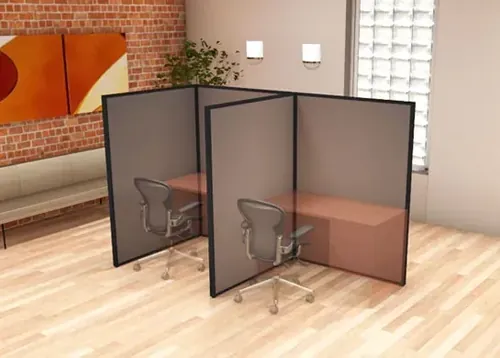
Office Partition Panels 66H L Shape 2Pack Inline
-
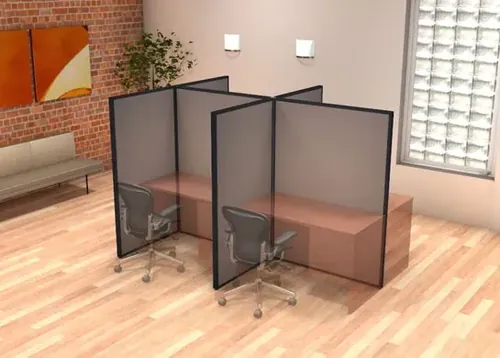
Office Partition Panels 66H T Shape 4Pack Cluster
-
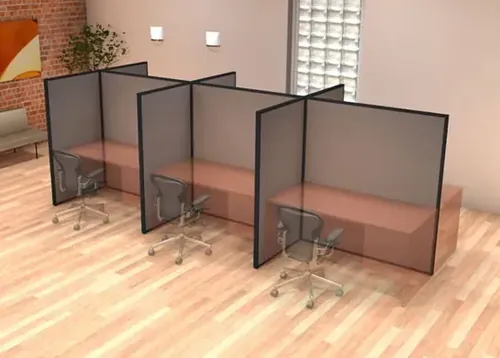
Office Partition Panels 66H T Shape 6 Pack Cluster
-
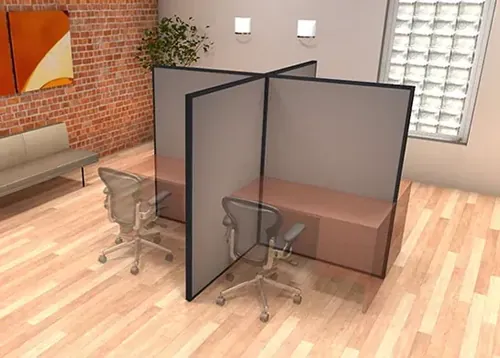
Office Partition Panels 66H X Shape 4Pack Cluster
-
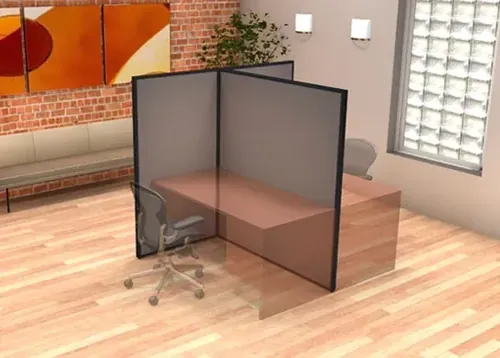
Office Partition Panels 66H T Shape 2Pack Cluster
-
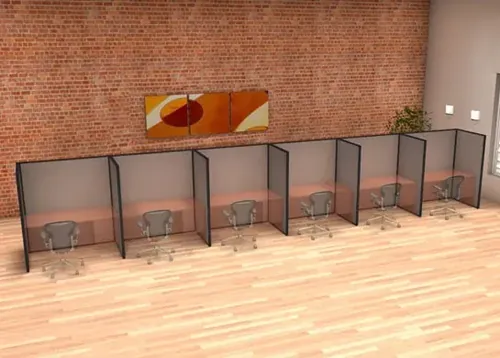
Office Partition Panels 66H U Shape 6Pack Inline
-
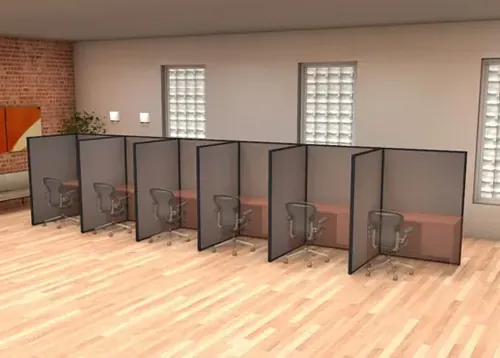
Office Partition Panels 66H L Shape 6Pack Inline
-
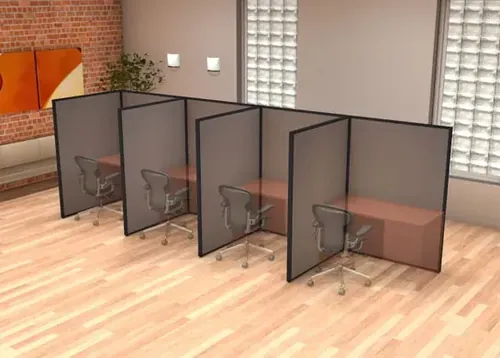
Office Partition Panels 66H L Shape 4Pack Inline
-
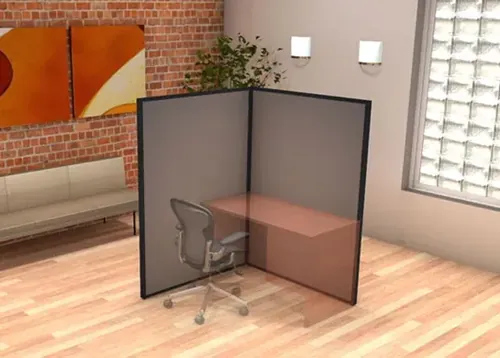
Office Partition Panels 66H L Shape Single
-
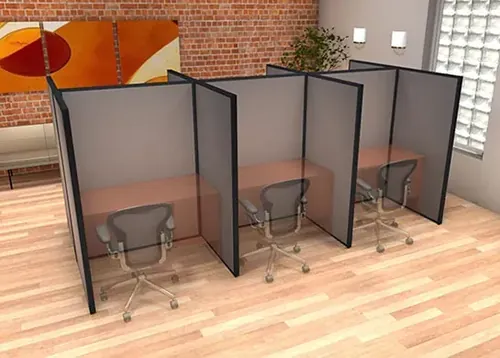
Office Partition Panels 66H U Shape 6Pack Cluster
-
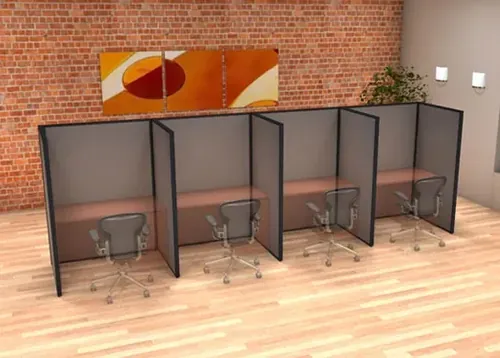
Office Partition Panels 66H U Shape 4Pack Inline
-
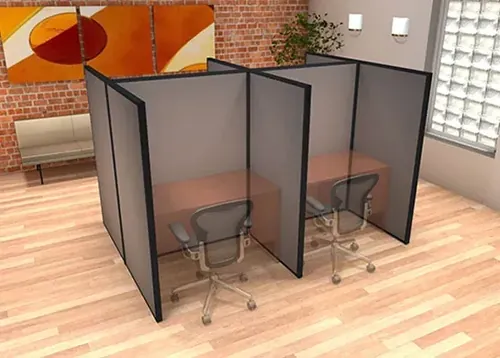
Office Partition Panels 66H U Shape 4Pack Cluster
-
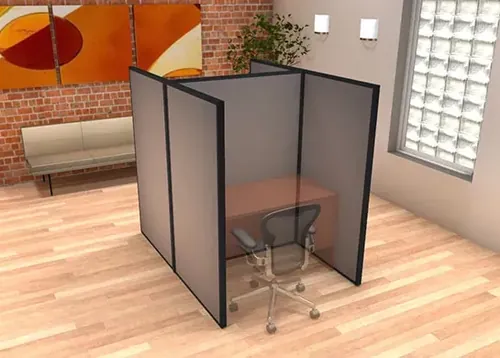
Office Partition Panels 66H U Shape 2Pack Cluster
-
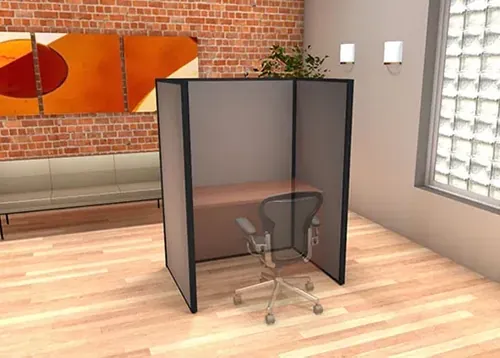
Office Partition Panels 66H U Shape Single
-
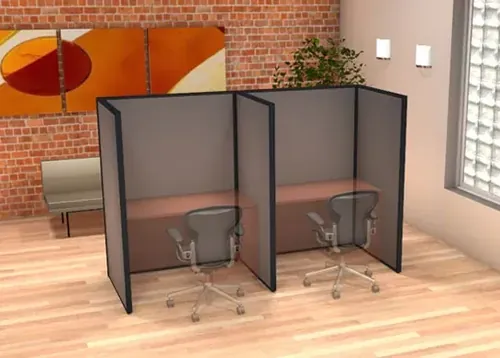
Office Partition Panels 66H U Shape 2Pack Inline
Many experts nowadays say that open space in offices can be unfavorable and even detrimental to productivity and job satisfaction, which makes a private partitioned space like the cubicle a more sound and attractive alternative, especially now that the modern cubicle isn't so gray, boxy and depressing like when it used to carry that dreadful and demonized past notoriety, thanks to pop culture.
In this article we will go into detail explaining the different types of space dividers and we'll give you some pros and cons of the cubicle setup, so that you can make a decision on how to choose the products that will best serve their purpose according to your needs.First, let's look at the pros and cons of closed office plans. In the past couple of decades, there's been a strong trend towards open office layouts and many companies have plunged into trying to make it work, sometimes just for the sake of its own, without carefully weighing the benefits and the drawbacks, and without looking at their facility configurations. Now, in the most recent years, we seem to be looking at a shift to seeing the value in returning to closed office plans. And by closed office, understand cubicle walls and other solid office partition panels. Of course, both office plans have their pros and cons, so let's look at the picture in its entirety:
First, we'll look at the benefits of the closed plan and the strongest point being privacy. Without the proper amount of privacy, you could hardly focus and knuckle down to any task at hand. In a buzzing open space, everything can be a distraction, and you see and hear everything and everyone all the time, as opposed to a traditional closed office, where those distractions are close to non-existent, and employees can home in on what needs to be done. Another major benefit of hard barriers like cubicle walls is to health. A partition screen does more than to simply divide space and minimize sounds and other distractions, namely it minimizes the transmission for colds and flu's. Generally, germs and viruses spread easily among people because of the proximity between people and by sharing objects, office equipment etc., and in an open office there is no stopping the vicious little bugs. Closed offices provide layers of cover, so that the microbes can die off while trying to close in on their pray after they get spread in the open air. Apart from those major pros of the closed office plan, there's also a little less obvious benefit, which not everyone might think of – a sense of ownership. Your workplace is like a second home away from home, and with some it's the place they'd spend at least the same amount of awake time they would in their own homes, if not even more. So, a lot of people are urged feel a sense of ownership or belonging and they make that space personal, they decorate the space between the modular wall panels with things they want and like, which can add to their efficiency, since they would feel more comfortable in a place they know is theirs and they know where things are.
Now, we're ought to mention the possible disadvantages of closed office spaces, and one of them, although not necessarily so, is space inefficiency. Cubicle farms, when not designed and configured properly, can be quite space inefficient, because they create some dead space that is sometimes ignored. So, in some cases, closed offices would require much more floor space than an open one. Another setback can be the cost. While open space is basically free, closed space requires room divider furniture, and that costs money and time needed to create or reconfigure partitions, when necessary. Of course, you can easily weigh this against the eventual profits you'd generate from the increased productivity resulting from the better focus of workers, while tackling their everyday tasks in private. Another drawback of closed space, in some cases, could be the lack of communication and collaboration and some level of general feeling of isolation. Privacy can be beneficial, but so can be collaboration, so it's really a matter of consideration of the nature of your company's work and on an individual basis.
Now, let's talk more on how to choose the right modern office partitions for your workplace. There are important decisions to be made and the first is the level of privacy you'd like in your office. Then you'll need to know what your options are and the effects of each one to the final outcome. When we speak of privacy levels, both visual and acoustical, there are several basic options.
Low-wall cubicles obviously don't afford much privacy, so the low-walled way can be used if you aim at fostering team work and tight collaboration and if you lean toward keeping your space open. It's as close of a choice as a simple benching system, actually, except maybe for a few features benches don't offer, such as the power/data cabling outlets that you can find in the bottom of some office panels, and some sense of your own space, which you could hardly have with a benching system.
Medium height wall panes are something you can safely call the “Great Compromise” of the semi-open office plan. Workers will have more privacy, but all they'll have to do is stand up from their chairs and everything becomes shared again and out in the open.
High office wall dividers offer considerably greater acoustical and visual privacy, as well as some other non-essential but beneficial opportunities, such as hanging open shelving and other work tools. Even standing, workers can't interact and peer into others' work space, which keeps work quiet, focused and distraction-free. These are especially useful if the work involves sensitive materials and conversations on regular basis, or if employees find it difficult to focus in noisier environments. Other benefits from the big and tall commercial room dividers is the great capacity for wire management – cable storage and distribution – and the possibility to attach full-height hanging shelves or overhead bins.
There are, nevertheless, a few setbacks to high cubicles, such as the eventual feeling of being somewhat isolated from co-workers or managers, bringing relations into a more formal state. In some cases, like with more conservative organizations that value concentration and discretion more than bonding and teamwork, for instance, this can be actually a plus. For most businesses that require collaboration and teamwork, while still wanting some degree of privacy, when and where it is needed, a blended solution can offer the best of both worlds. You can configure your workstations using panels of different heights.
Demountable full height room partition walls are similar to cubicle systems, except they are floor-to-ceiling and act as real, hard walls. Most of those allow modular furniture components to be attached to the system, as well as to run power and cabling, and they also offer different, attractive surface options to best match any existing office décor. They can also be moved and reconfigured relatively easier, as major changes at the workplace occur, and it will be considerably less costly to move these free standing office partitions than it would be with, say, dry walls.
In conclusion, while it is virtually impossible to predict what awaits your workplace in the future, movable office panels are a versatile, efficient and viable way to solve partitioning issues and meet practically any specific need in that direction. Seeing and understanding what your options are gives you the power to make the best and most informed decision possible. And if you need some additional assistance during your choosing process, our experts will be happy to lend a helping hand.