


Office Trailers
Discover the versatility and multifaceted nature of office trailers. They are a portable, all-encompassing workspace solution for various needs.
Mobile office trailers are adaptable structures that can serve a wide range of purposes. They can be used as temporary offices during construction projects, mobile classrooms for schools, on site facilities for events or festivals, or even as medical clinics during emergencies. Their versatility makes them suitable for different industries and applications.
They provide a flexible and portable workspace solution. Unlike traditional buildings, they can be easily transported to different locations as needed. This portability allows businesses and organizations to set up functional workspaces quickly and efficiently, even in remote or temporary locations.
Office trailers address a specific need or challenge faced by businesses and organizations. Whether it's a need for additional office space, a temporary workspace solution, or a portable facility for specific activities, an office trailer offers a practical and effective answer to these requirements.
Departmental Trailers
INTRODUCTION
An office trailer is a flexible and efficient solution for businesses in need of temporary or mobile workspaces. With their customizable layouts and quick setup, onsite facilities offer a convenient way to expand your office space or establish a new location.
Featuring durable construction and modern amenities, these portable workspaces provide a comfortable and productive environment for teams of all sizes. Whether you're in need of extra office space during renovations, temporary facilities for construction sites, or a mobile office for on-site projects, office trailers are the ideal solution.
With a history of versatility and reliability, they have been utilized across various industries, from construction and education to healthcare and government. Explore how these movable office spaces have transformed workspaces and meet the evolving needs of businesses worldwide.
HISTORY
Before the modern era of construction trailers life at construction sites was markedly different. Workers relied on simple accommodations, often makeshift shelters constructed from wood or other available materials, which provided only basic protection from the elements. This accommodation lacked the comfort and convenience of today’s modern office trailer, offering little more than shelter.
Amenities were limited without the presence of portable office spaces. Workers might have had access to rudimentary facilities like portable toilets and makeshift washing areas, but amenities such as heating, air conditioning, and proper sanitation were often minimal or absent altogether.
Communication and coordination were more challenging in the absence of centralized workspaces provided by trailer office spaces. Foremen and supervisors had to physically move around the site to convey instructions or gather information from workers, leading to inefficiencies and potential delays in project execution.

Storage and planning also presented challenges without the storage space offered by trailers. Materials and equipment were often scattered around the site or stored in makeshift areas, requiring extra effort in planning and organization, which could impact efficiency.
The lack of central “office space” influenced social dynamics among workers. Interaction between different teams or groups of workers may have been less frequent, as there was no common area for meetings or breaks.
Overall, life at construction sites before the era of sturdy and dependable trailers was characterized by simpler accommodations, decentralized communication, and greater challenges in organization and coordination.
Initially, construction work trailers were simple structures, often consisting of converted railroad cars or makeshift wooden sheds, placed on building site for use as storage and temporary offices for project managers, engineers, and administrative staff. Then Jack Hempson and his Alberta team were given the task of coming up with a better idea.
Previously used as temporary structures on construction sites, these “Alberta-Built” mobile workspaces grew to provide various functions including on-site offices facilities. Over time their versatility and convenience led to adoption for uses beyond the construction site in various application and business sectors, including education, healthcare, and government.
Traditional brick-and-mortar or stick-built temporary construction site buildings became obsolete due to their cost, time-consuming construction process, and lack of mobility. As a result, the concept of mobile modular office trailers was born.
As construction projects grew in complexity and expanded geographically during the early 20th century, the demand for construction trailers as mobile and reusable on site facilities emerged to aid in project management and coordination.
As construction practices evolved and the demand for temporary workspaces increased, so did the design and functionality of these structures. Manufacturers began producing purpose-built trailers designed specifically for office use, incorporating features such as heating, air conditioning, electricity, and plumbing to provide a comfortable and functional workspace for occupants.
Over time, the versatility and convenience of these structures led to their adoption in various other industries beyond construction. In the education sector, for example trailers were repurposed as portable classrooms to accommodate growing student populations or to provide temporary facilities during school renovations or expansions.
Today, office trailers continue to play an important role in providing flexible, cost-effective, and customizable workspace solutions across a wide range of industries. Their rich history reflects their evolution from simple, makeshift structures to sophisticated, purpose-built facilities, and their continued use highlights how valuable they are as a productive resource for businesses, organizations, and communities alike.
ANATOMY OF TRAILERS
Construction trailer design irrespective of its use is depicted in this detailed illustration. From the exterior features to interior layout, this image provides an insightful look into the elements that make up the build of these versatile mobile workspaces.
|
1. BASE FRAME |
2. UNDERCARRIAGE |
3. EXTERIOR BOTTOM |
4. FLOOR JOIST |
|
5. FLOOR INSULATION |
6. FLOOR DECKING |
7. FLOOR COVERING |
8. WALL FRAMING |
|
9. WALL INSULATION |
10. INTERIOR WALL COVERING |
11. EXTERIOR WALL COVERING |
12. INTERIOR CEILING |
|
13. ROOF INSULATION |
14. ROOF FRAMING |
15. EXTERIOR ROOF SHEATHING |
16. ROOF COVERING |
|
17. EXTERIOR DOORS |
18. WINDOWS |
|

ADVANTAGES
1. Cost-Effectiveness: Office space trailers are typically more cost-effective than constructing a traditional office building. They can provide a quick and affordable solution for temporary space needs.
2. Speed of Deployment: The office trailer cost is obviously less when compared to constructing a traditional building. This quick deployment is particularly advantageous for projects with tight timelines or where brick and mortar are not practical or feasible.
3. Flexibility and Mobility: It’s no surprise that the office trailer is mobile and can be easily relocated to different sites. This makes them an excellent choice for projects that require flexibility or for businesses with changing operational locations.
4. Temporary Space Needs: When office space planning requires a short-term solution, such as during construction projects, events, or temporary office setups, choosing from a variety of mobile office trailer floor plans offers a practical and flexible option.
5. Reduced Site Disruption: Using jobsite trailers can minimize disruption to existing facilities or landscapes, as they are separate structures that can be placed without major construction work.
6. Versatility in Applications: Mobile modular office trailers can be used in a wide range of applications, including construction sites, events, disaster response, and more. They are adaptable to different industries and settings.
7. Customization Options: Mobile office trailer floor plans are customizable to meet specific needs. Users can choose from different office trailer dimensions, layouts, and features to tailor the space to their requirements.
8. Energy Efficiency: Modern office trailers are often designed with energy-efficient features, contributing to cost savings and environmental considerations.
9. Temporary or Remote Locations: In situations where establishing a permanent office in a remote location is impractical, an office trailer provides a mobile and temporary solution.
10. Scalability: Ask Will Scott Office Trailers and they’ll tell you that trailers can be easily combined to create larger complexes or scaled down for smaller projects, providing scalability based on the project's needs.
11. Regulatory Compliance: Work office trailers typically meet building codes and regulations, ensuring compliance with local requirements.
However, it's important to note that office trailers may not be suitable for every scenario. For long-term office needs, projects in urban areas with strict zoning regulations, or situations where a permanent or prestigious address is required, a traditional office building may be a more suitable choice. The decision often depends on the specific requirements and constraints of the project or business.
THINGS TO CONSIDER
Selecting the right jobsite office trailers is essential for businesses looking to expand their workspace or establish a temporary office solution. However, navigating the selection process demands a clear understanding of your specific needs and priorities.
Several factors should be considered when making this decision, office trailer dimensions, layout, features, and budget. Whether it's for construction sites, educational facilities, healthcare services, or events, choosing the right trailer solution ensures a functional and efficient workspace for your business operations.
In this guide, we'll explore key factors to consider when selecting this mobile office space, helping you make an informed decision tailored to your business requirements.
-
Budget: Assessing your budgetary constraints is paramount. Determining the office trailer cost and the financial resources available for procuring and maintaining these office facilities align with your financial plans.
-
Head Count: Consider the size of your workforce to ensure the trailer provides adequate space and amenities to accommodate everyone comfortably.
-
Trailer Site Size: Evaluate the available square footage of the location where the trailer will be placed. Factors to consider include available space to accommodate the trailer itself along with accommodations for ingress/egress accessibility, and any site-specific considerations.
-
Amenities: Identify essential office trailer interior amenities required to support your employees' productivity and well-being, such as heating, air conditioning, restroom facilities, and kitchenette areas.
-
ADA Workplace Requirements: Ensure compliance with ADA regulations by assessing accessibility features such as ramps, wider doorways, and designated parking spaces for individuals with disabilities.
-
Office Trailer Design: Determine the primary function of each on site facilities, whether it serves as administrative, conference, training, break areas, or other specific purpose to tailor each office trailer layout accordingly to its specific function.
-
Shared or Private Office: Determine whether the office trailer will function as a shared workspace for collaborative activities or if individual offices are necessary to accommodate confidential tasks and meetings.
-
Flexible Office Furniture: Evaluate the workspace layout requirements based on the departmental work flows to determine the optimal office furniture setup that best suits organizational needs and user preferences, i.e. traditional desks verses small cubicles.
By carefully considering these key factors, you can select an office trailer solution that meets your immediate needs and aligns with your long-term business objectives.
BUYING vs. RENTING
Buying Office Trailers
The choice between buying and/or looking for an office trailer for rent hinges largely on the anticipated duration of its usage and the office trailer cost.
This pivotal decision requires careful consideration, as it directly impacts both short-term flexibility and long-term financial planning. Below, we outline essential factors to weigh when navigating this decision-making process, ensuring you make a well-informed choice tailored to your specific circumstances.
-
Companies specialized in the topic state that, if the office will be needed for 3 years or more, it is advisable to purchase your jobsite office trailer.
-
If the time of use is uncertain, but likely to be longer than 3 years consider lease-to-own options thereby giving yourself a built-in exit strategy.
-
Consider any additional fees when buying a new office trailer i.e. dealer fees, sales tax, transportation charges, titles and registration fees, etc.
Buying used office trailers is another viable option. It is a good idea to check if there are any used office trailers for sale near where you intend to “park” your trailer.
Renting Office Trailers
For short-term mobile office requirements, renting is a worthy option. Renting offers the flexibility of a temporary solution and eliminates many of the cost burdens of ownership (acquisition, disposition, relocation, etc.).
When looking for office trailers for rent while aiming to manage costs effectively, it is necessary to consider any potential additional fees or expenses:
-
Delivery cost: Consider the expenses associated with transporting the jobsite office trailer to your desired location. Delivery charges may vary based on distance, accessibility of the site, and transportation method.
-
Set-up cost: Factor in the costs involved in setting up the portable office space upon delivery. This includes assembly, leveling, and securing the trailer to ensure it meets safety and regulatory standards.
-
Utility installation: Assess the requirements for installing essential utilities such as plumbing and electrical connections. Depending on your needs, you may incur additional expenses for hooking up water supply, sewage disposal, electricity, and other utilities.
-
Removal costs: Plan for the expenses associated with removal once it's no longer needed. Removal costs may include disassembly, transportation of the trailer from the site, and any necessary site restoration to return the area to its original condition.
Consider these additional costs alongside the rental price of the portable office trailer, so that you can better estimate the total expenditure involved and make informed decisions to manage your budget effectively.
COMMON USERS
Several industries have historically been significant users of jobsite office trailers, leveraging their flexibility and mobility for temporary office space needs. Some of these industries include:
1. Construction: Construction trailers are a common presence at building locations. These on-site offices play a vital role in project management, coordination, and administrative tasks.
2. Oil and Gas: In the oil and gas industry, where projects are often located in remote or temporary settings, a construction trailer office is part and parcel of efficient on-site operations.
3. Events and Entertainment: Concerts, festivals, and sporting events often utilize office trailers as command centers, ticket booths, and/or administrative offices for event organizers. It’s not uncommon to find luxury mobile office trailers on site for VIP’s.
4. Disaster Response and Emergency Services: Emergency response organizations use office trailers as command centers and administrative hubs during disaster response efforts.
5. Education: Educational institutions, especially schools and universities create classroom trailers during construction or renovation projects to maintain administrative functions or provide temporary classrooms. Trailers are even used to add to seat capacity when traditional buildings are maxed out.
6. Film and Television Production: Movie Set Trailers are essential for film and television location shoots, often serving as production offices that provide workspace for directors, producers, and other staff. And don’t forget VIP Trailers for the stars!
7. Government and Municipalities: Federal, State and City Governmental agencies and local municipalities may deploy office space trailers for seasonal or short term projects such as elections, at disaster recovery locations, or for other short-term needs.
8. Transportation and Infrastructure Projects: During road improvement or bridge and tunnel construction projects mobile modular office trailers serve a pivotal role in project management and coordination.
9. Healthcare: In the healthcare industry hospital facility office space planners will consider trailers as temporary administrative offices or medical clinics during construction or renovation of existing facilities.
10. Retail: Traditional brick and mortar retailers undergoing renovations or expansions may use office trailers as temporary office space for store management and administrative functions.
Any business, in most any industry, can benefit from the mobility, quick deployment, and cost-effectiveness of trailers in situations where permanent built structures may not be practical, feasible or necessary. The versatility of trailers makes them an asset for a wide range of applications across different uses and business sectors.
|
|
|
|
|
|
|
|
|
|
|
|


OFFICE TRAILER INTERIOR LAYOUT IDEAS
Introducing a world of innovative office trailer layout designs, where inspiration meets functionality.
From streamlined administrative spaces to optimized engineering workstations with architectural plan storage these mobile office trailer interior designs offer you a blueprint when you are in the market for mobile office trailer floor plans.
Each configuration is meticulously designed by our office space planning professionals to ensure maximum space utilization and optimized workflows.
Explore our series of inspirational and versatile office trailers tailored to meet the departmental needs of typical businesses:
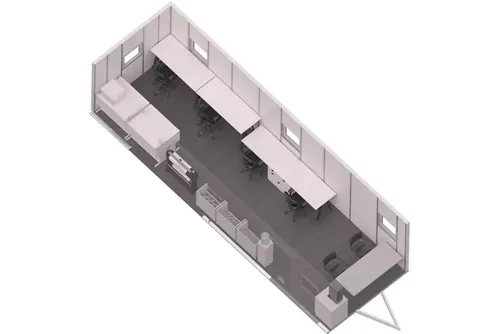
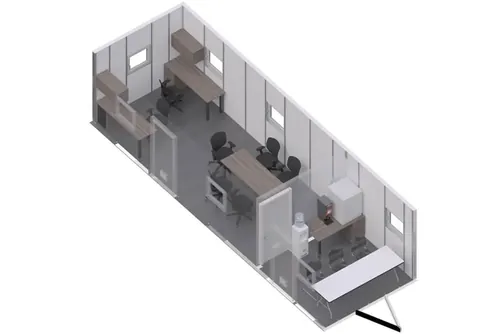
Engineering Trailer
This office trailer interior has an engineering desk setup optimized for engineers and architects.
Especially tailored for engineering and architectural projects, it is equipped with office furniture pieces specific to the needs of its inhabitants with key features that include professional drafting tables, drafting stools, a blueprint file cabinet and a mobile roll file designed for architectural plan storage.
Each element fosters a construction jobsite trailer office environment optimized to the specific needs of those who design, plan and build what’s being built.

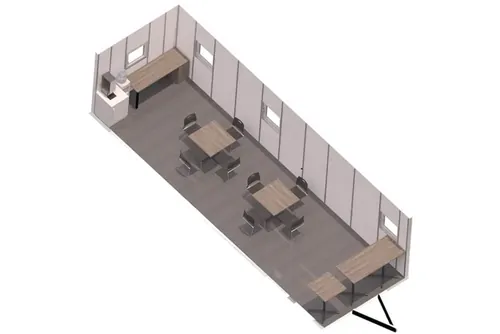
Portable break room
Relax and recharge in style with our break room trailer, designed to provide a comfortable retreat for employees. This inviting space encourages relaxation and revitalization, whether you're enjoying a coffee break or catching up with colleagues. The pantry area features two 36” pantry tables perfect for casual gatherings or group discussions, a 30” office bar height table ideal for quick breaks or relaxed chats, a 30”x72” tall office table for larger groups, and a 70”x30” straight desk with a box box file pedestal that combines dining with functional storage. The office seating includes eight stackable office chairs, offering flexible and comfortable seating options. This thoughtfully designed portable break room trailer not only provides the necessary furniture for relaxation and socialization but also ensures that each piece contributes to a rejuvenating office environment.

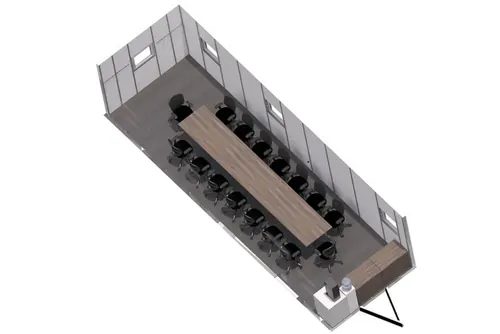
Mobile Conference Room
This 32’ mobile office trailer interior is outfitted with a long meeting table perfect to host meetings, give presentations, and have those all-important brainstorming sessions (how to “unstuck” that crane).
This long table is a highly affordable 36” wide x 72” long laminate conference table configured in a 3-pack formation to create an 18’ conference table. These tables, as with all our office trailer floor plans are from our visually pleasing choice line of laminate office furniture, prized for their affordable durability.
With our customizable office trailer designs and layouts we can help you create a mobile office meeting space with the right conference room equipment setup for productive discussions and strategic planning.


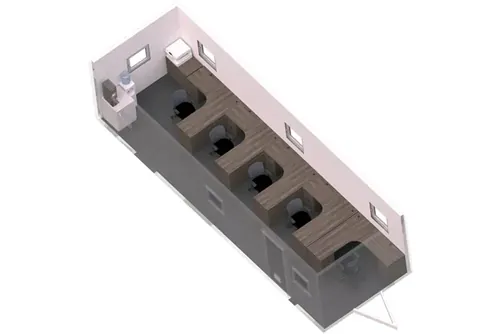
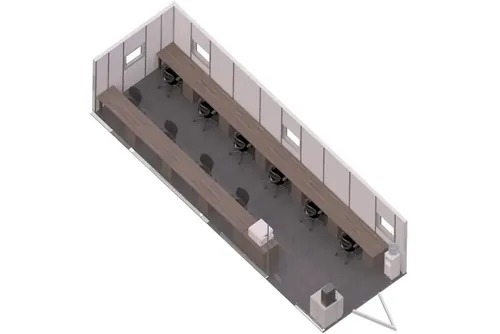
Office Space Optimization Trailer
Is an office space planning approach that seeks to maximize available floor space by arranging desk workstations along the perimeter walls. This office room layout frees up central floor space making the room feel larger and more open and is especially beneficial in small or narrow rooms.
Key features of this office furniture setup include 10 (60"x24") straight desks with box box file pedestal each, a printer stand with drawers, and 10 task office chairs. Each element is carefully selected to create a streamlined and productive office setup.

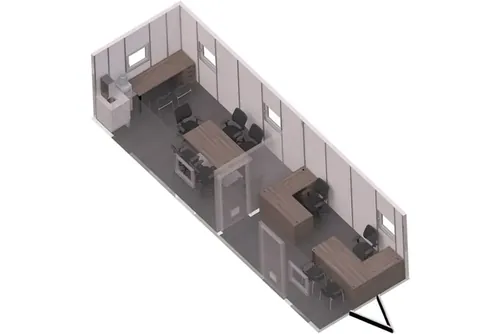
Construction Manager Office Trailer
A workspace tailored for executives and managers; this trailer office space features two distinct workspaces.
The executive office space is equipped with 72"x66" and 60"x60" office L desks with desk pedestals, two office task chairs, and two guest chairs, creating a great environment for focused everyday work.
The second workspace includes a 72"x36" office conference table with six conference chairs, a 72"x24" pantry table with a cabinet pedestal, and two stackable chairs. This office setup provides a space for meetings or taking a break from a busy day.
This construction management office trailer offers a comfortable, functional, and well-equipped trailer office space designed for leadership.

OFFICE TRAILER FLOOR PLANS
Our inspirational designs feature details crafted to inspire success and drive innovation. Let your imagination soar as you explore the endless possibilities of portable office trailers.
Office trailers offer versatile and efficient interior layouts designed to meet the diverse needs of various industries and projects.
These mobile workspaces feature carefully planned configurations that maximize functionality and comfort within a compact footprint. From an open plan office layout conducive to collaboration and communication to a partitioned office space providing privacy for focused work, office trailers cater to a range of organizational requirements.
Equipped with amenities such as desks, chairs, storage solutions, and often customizable options, these interiors offer a seamless blend of convenience and functionality for on-site operations.
Accounting Office Trailer Layout

Engineering-Architectural Construction Trailer Layout

Breakroom Office Trailer Layout

Conference Trailer Layout

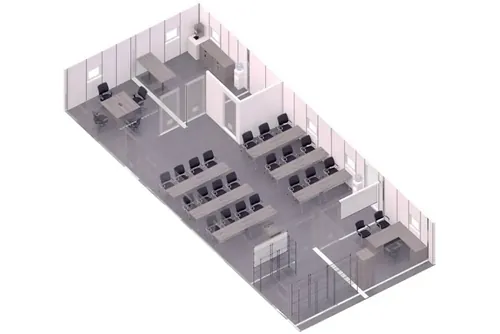
Training Double Wide Mobile Office Trailer Layout

Space Optimization Office Trailer Layout

Construction Trailer Ideas - Manager Office

CASE STUDIES
Case #1:
A construction company undertook the task of building a bridge linking two states along the East Coast. Given the scale and duration of the project, the company required adequate space to house a large workforce comprising workers, engineers, architects, and crews.
To meet this demand, the company installed five mobile office trailers capable of accommodating up to 350 employees. Each trailer was outfitted with various layouts to serve different functions, including private offices, conference rooms, large meeting areas, kitchens, and restrooms.
The utilization of these temporary office solutions by the construction company, exemplifies a proactive approach to addressing the spatial requirements of a major infrastructure project. Through these strategically placed trailers, the company effectively fosters collaboration and efficiency among workers, engineers, and architects. This case study highlights the pivotal role of mobile office solutions in facilitating seamless operations and communication on large-scale construction endeavors.


Woodrow Wilson Bridge
Photo: HardestyHanover.com
Case #2:
A car dealership needed to renovate their office to keep pace with competitors. To avoid loss of profit from having to stop during the renovation time, they ordered mobile offices fully equipped to keep their business working. The trailer was allotted in the same location of the dealership and the company was fully operational on site.

Case #3:
This project demonstrates our multi-step process for taking empty temporary office structures and transforming them into comfortable, functional, and efficient workspaces. By leveraging our highly trained office space design layout team and our decades of office furniture market knowledge we can create an environment that nurtures productivity, promotes efficient workflows, and meets the unique needs of any business.
EMPTY TRAILER LAYOUT
Step 1 – Define Physical Parameters & Office Space Planning Objectives

Step 2 – Understand Intradepartmental Communications & Workflows – Formulate Programmatic Space Planning for Commercial Office Interiors

Step 3 – Create Detailed 2D CAD Drawings of New Office Layouts

Step 4 – Create a 3D Birdseye View for Enhanced Understanding

OFFICE CONTAINERS
Shipping container offices have emerged as a popular alternative to the traditional mobile modular office trailers. The office container is one of many applications created from repurposed shipping containers. Yes, people even use shipping containers as homes.

Shipping containers offer several unique advantages. They are known for their durability, as they are designed to carry very heavy loads and withstand long-term exposure to harsh marine environments. This built-in toughness makes them exceptionally strong and long-lasting as land based structures.
The shipping container office layout can be customized to your business’ specific needs. Adding windows, doors, insulation, electrical and plumbing systems are essential to make a shipping container office space. Adding modular office walls can aid in the creation of comfortable and functional workspaces tailored to serve various requirements.
A shipping container as office offer the same benefits as modern office trailers with the added benefits of possessing a more durable asset. Made from high-grade, high gauge welded steel, they are highly resistant to the elements, ensuring longevity through the seasons and across many years.
|
|
|
|
|
|
|
|
|
|
|
|


For a deeper dive into the practicality of shipping container office space or for that matter converting a shipping container for human inhabitation check out this 2019 study from the School Of Architecture at India’s Modi University.
Many Office Container Design Ideas offer a sustainable and flexible solution while repurposing existing materials to create a modern workspace.
The process of transforming shipping containers into functional office spaces is both innovative and efficient.
This transformation typically begins with selecting high-quality containers that are structurally sound. Once chosen, the containers undergo a thorough cleaning and refurbishment process to ensure they are ready for modification.
The next step involves customizing the shipping container office layout to satisfy your exacting requirements. This can include cutting out sections to add windows and doors, insulating the interior to maintain comfortable temperatures, and installing electrical and plumbing systems exactly where you want them.
You can see the process for yourself by viewing these helpful videos about Repurposed shipping containers converted to offices. If you’re not the DIY type you can contact Pentalver to do it for you.

The bottom line is, as always, nontraditional thinking invariably offers unique ideas, and unique ideas can produce outcomes that produce beneficial results.